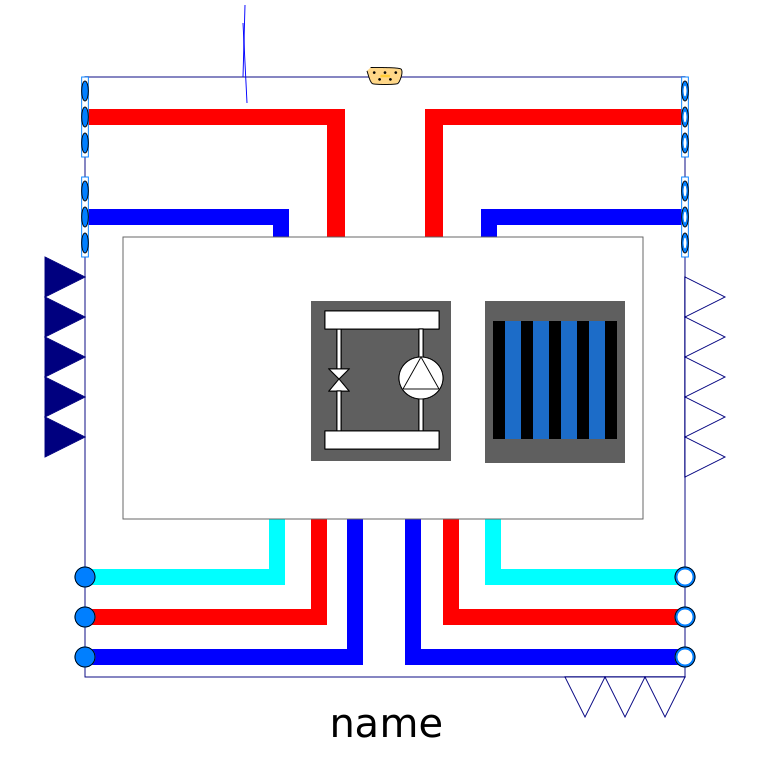
 .Buildings.DHC.ETS.Combined.HeatRecoveryHeatPump .Buildings.DHC.ETS.Combined.HeatRecoveryHeatPump
Model of an Energy Transfer Station with heat recovery heat pump, buffer tanks and optional domestic hot water preparation and optional water-side economizer.
The figure below shows the schematic diagram. The heat recovery heat pump preferentially operates in heat recovery mode, but if heating (or cooling) demand persists while the cold (or hot) water-side buffer tank is fully charged, the evaporator (or condenser) temperature is reset, the corresponding tank is decoupled to avoid flushing the tank, and heat is exchanged with the district energy system.
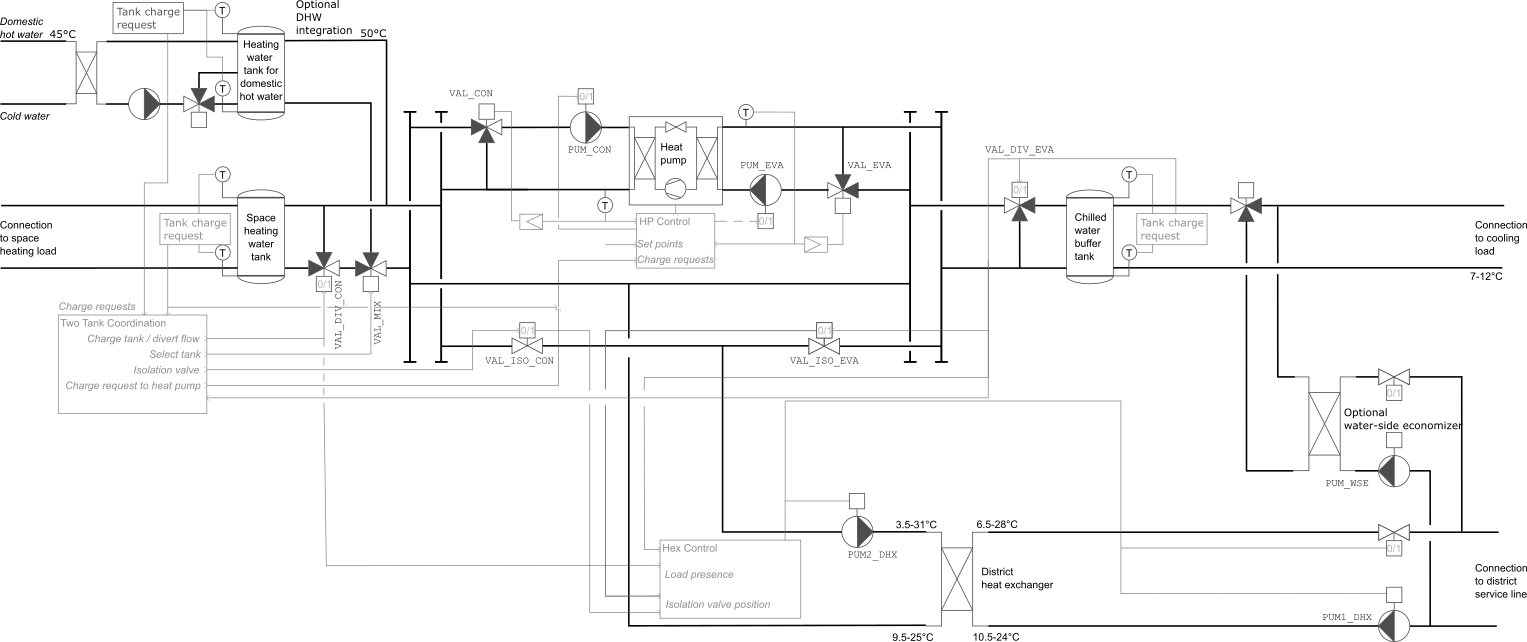
The operation is as follows:
The chilled water and heating hot water tanks are by default sized for five minutes and used as buffer tanks. The DHW tank is by default sized for 24 hours of storage. Each tank generates a signal to request charging. If the temperature of its supply side (top for the hot tank, bottom for the cold tank) deviates from the set point with hysteresis, charging is enabled until the temperature of its return side (bottom for the hot tank, top for the cold tank) achieves the set point with hysteresis.
When the space heating or cooling tank does not request
charging, the diversion valve VAL_DIV_CON or
VAL_DIV_EVA to the respective tank is closed, and the
isolation valve VAL_ISO_CON or
VAL_ISO_EVA is opened to allow energy exchange with
the district heat exchanger. The diversion valves are necessary
because, for example, when the ETS operates cooling only mode,
rejecting heat to the ambient loop, the condenser outputs hot water
at the minimum leaving temperature is 15°C. Without the
diversion valve, the cool water from the condenser would flush out
the energy stored in the space heating tank. This causes energy
waste. It also causes short cycling because the tank will request
charging repeatedly as its temperature falls below the heating set
point, bring the system into a limit cycle.
The integration of the DHW tank is optional, as not all buildings prepare DHW using the ETS. When integrated, the space heating and DHW tank share the same condenser loop. The table below explains how the two loops are coordinated through valve control.
| Charge signal | Controller output | ||
|---|---|---|---|
| DHW | HHW | ymix | ydiv |
| on | on | 0.5 | 1 |
| on | off | 0 | 1 |
| off | on | 1 | 1 |
| off | off | 1 | 0 |
The heat recovery heat pump can produce heating, cooling, or
both simultaneously. The condenser pump PUM_CON and
the evaporator pump PUM_EVA are enabled when any of
the respective tanks requests charging. The heat pump is turned on
30 seconds after PUM_CON and
PUM_EVA are running.
When on, the primary pumps are operated at constant speed, and
the condenser (resp. evaporator) mixing valve VAL_CON
(resp. VAL_EVA) are modulated with a P controller to
track the set point for the water that leaves the heat pump, with a
small offset to open first the valve and then ramp up the
compressor speed.
The compressor speed is controlled based on the same temperature measurement as the mixing valves. Based on a moving average of the compressor speed signal for heating and cooling, the heat pump control is switched into heating or cooling dominated operation, and the respective compressor speed setpoint is sent to the heat pump.
If only heating (or only cooling) is requested from the tank, then the evaporator (or condenser) set point temperature is reset to minimize the temperature lift across the heat pump.
The district heat exchanger hydraulically decouples the
buildings system and the district system. Its primary and secondary
circuits are enabled to operate if either any of the tanks request
charging, and if an isolation valve VAL_ISO_CON or
VAL_ISO_EVA is open. When enabled, the pumps
PUM1_DHX and PUM2_DHX operate at a
constant speed.
The set points for the supply temperatures are input to this
model. For the heating supply water, use
THeaWatSupSet, for the cooling supply water, use
TChiWatSupSet.
If a domestic hot water supply is present, as declared through
the parameter have_hotWat, then use
THotWatSupSet for the set point temperature to the end
user (such as shower), and use TColWat for the
temperature of the cold water supply and
QReqHotWat_flow for the heat flow rate associated with
the hot water supply, i.e., QReqHotWat_flow = mHotWat_flow
cwat (THotWatSupSet-TColWat), where
mHotWat_flow is the hot water mass flow rate, and
cwat is the specific heat capacity of
water.
The DHW preparation is optional. If present, a fresh water station is used. The fresh water station allows to store heat in the heating rather than the domestic hot water, therefore avoiding the potential problem of Legionella bacteria getting from the hot water tank to the DHW circuit. This allows to operate the storage at a lower temperature, thereby increasing the heat pump COP.
The integration of the domestic hot water is further described in Buildings.DHC.ETS.Combined.Subsystems.DHWConsumption, which uses the fresh water station that is described and shown with a schematic diagram at Buildings.DHC.ETS.Combined.Subsystems.StorageTankWithExternalHeatExchanger.
The water-side economizer is optional. Use of the water-side economizer can improve resilience during heat waves when power consumption of the ETS need to be curtailed by switching of the chiller, for example during a grid outage when the site operates on emergency power.
To use the water-side economizer, if the temperature conditions are favorable, the valves (or pumps) are activated in order to cool the chilled water supply to the building. This model and its operation is described in Buildings.DHC.ETS.Combined.Subsystems.WatersideEconomizer. and in Gautier et al. (2022).
Antoine Gautier, Michael Wetter and Matthias Sulzer.
Resilient
cooling through geothermal district energy system.
Applied Energy, 325, November, 2022.