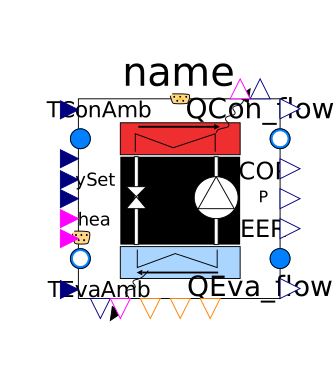
 .Buildings.Fluid.HeatPumps.ModularReversible.TableData2DLoadDepSHC .Buildings.Fluid.HeatPumps.ModularReversible.TableData2DLoadDepSHC
This is a model for simultaneous heating and cooling (SHC) air-to-water heat pumps (also referred to as 4-pipe polyvalent units or "Type A" in Eurovent, 2025), where the capacity and power are interpolated from manufacturer data along the source and sink temperature and the part load ratio (PLR).1
All kinds of capacity-modulation processes are supported, such as VFD-driven compressors, multiple on-off compressors, and single compressor cycling.
The model supports modeling both modular (nUni >
1) and single-unit (nUni = 1) systems. When
modeling modular systems, the staging logic for multiple modules is
included, but the HW and CHW isolation valves are not. However, the
model includes the calculation of the flow characteristic of an
equivalent actuator model to simplify the modeling of isolation
valves. The model also provides control variables for these valves,
or for primary pumps that are not controlled based on Δp. See
Section "Implementation details" for further explanations.
The model includes ideal controls that solve for the HW or CHW
supply or return temperature setpoint within the capacity limit.
The Boolean parameter use_TLoaLvgForCtl is used for
toggling between supply or return temperature control. The default
setting use_TLoaLvgForCtl = true corresponds to supply
temperature control.
For a comprehensive description of the algorithm and underlying assumptions, please refer to the documentation of Buildings.Fluid.HeatPumps.ModularReversible.RefrigerantCycle.BaseClasses.TableData2DLoadDepSHC. This documentation also explains the required format for the performance data file.
1 The part load ratio is used as a proxy variable for the actual capacity modulation observable. A discrete observable such as the number of operating compressors for systems with multiple on/off compressors is converted into a continuous PLR value and the model only approximates the system performance on a time average.
The following input signals are available.
onHea (Boolean,
scalar)onCoo (Boolean,
scalar)THwSet (real,
scalar)use_TLoaLvgForCtl.TChwSet (real,
scalar)use_TLoaLvgForCtl.The following output signals are available.
yValHwIso
(real, scalar)yValChwIso
(real, scalar)y1HwValIsoPumPri (Boolean, 1D-array of dimension
nUni)y1ChwValIsoPumPri (Boolean, 1D-array of dimension
nUni)Modular systems are typically installed with HW and CHW
isolation valves for each module. The model does not include these
valves. Furthermore, the model aggregates all modules into an
equivalent heating or cooling system. For integration into a plant
model, the recommended approach consists of using a single instance
of Buildings.Fluid.Actuators.Valves.TwoWayPolynomial
to represent the parallel network of HW isolation valves in series
with the modules' condenser barrels, and another instance to
represent the parallel network of CHW isolation valves in series
with the modules' evaporator barrels. The heat pump model must then
be configured with use_preDro = false to inhibit the
heat exchanger pressure drop calculation.
The actuator model can be parameterized with the flow
characteristic chaValHwIso (resp.
chaValChwIso) which is calculated by the current model
to ensure that a fractional opening of 1 / i results
in a mass flow rate of mCon_flow_nominal / i (resp.
mEva_flow_nominal / i) when the model is subjected to
a differential pressure of dpHw_nominal on the HW side
(resp. dpChw_nominal on the CHW side). The flow
characteristic is calculated under the assumption that the heat
pump heat exchanger flow resistance is lumped with the actuator
flow resistance, which yields the following expression for the
characteristic:
φ(y) = (y2 * dpValIso_nominal / (dpValIso_nominal
+ dp<Hw|Chw>_nominal * (1 -
y2)))1/2
,
where y = 1 / i is the fractional opening of the
equivalent actuator when a number of i modules are
enabled on the HW or CHW side, and dpValIso_nominal is
the isolation valve pressure drop at design flow.
Note that at least one HW isolation valve (resp. CHW isolation
valve) must be open when the heat pump is in SHC or heating-only
mode (resp. SHC or cooling-only mode), irrespective of any modules
being staged on. This is a requirement for proper load calculation
in the staging logic. This requirement is taken into account in the
calculation of the control variables for the equivalent actuator
yValHwIso and yValChwIso.
This approach is illustrated in the example models Buildings.Fluid.HeatPumps.ModularReversible.Examples.TableData2DLoadDepSHC1Only and Buildings.Fluid.HeatPumps.ModularReversible.Examples.TableData2DLoadDepSHC1And2 that showcase the use of this heat pump model in conjunction with equivalent actuator models in a primary-only and constant primary-secondary plant model.
Alternatively, the model also provides the Boolean array
connectors y1HwValIsoPumPri[nUni] and
y1ChwValIsoPumPri[nUni] that can be used to control an
explicit parallel arrangement of isolation valves or primary pumps.
These variables use the same requirement as above and their first
element is true based on the system operating mode
command, irrespective of any modules being staged on.
| Name | Description |
|---|---|
 RefrigerantCycleHeatPumpHeating RefrigerantCycleHeatPumpHeating |
Refrigerant cycle module for the heating mode |
 RefrigerantCycleHeatPumpCooling RefrigerantCycleHeatPumpCooling |
Refrigerant cycle module for the cooling mode |